
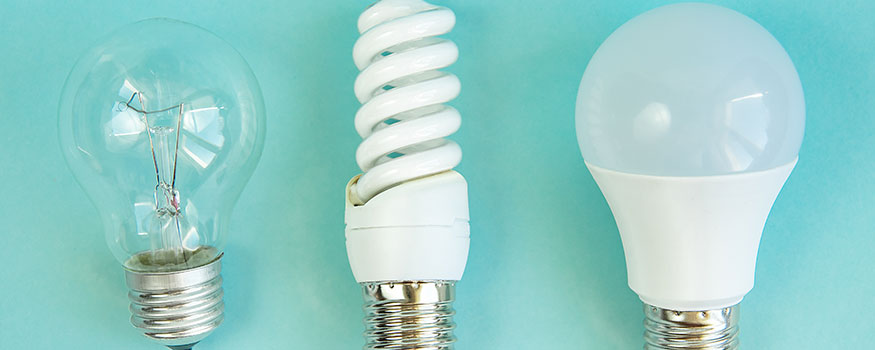
LED bulbs are based on light-emitting diode technology and CFL bulbs are based on compact fluorescent technology. Both are popular choices for home lighting in the US, particularly when people want to trim their power bills and curb consumption.
They both have their strengths and tradeoffs, from longevity to initial cost. To assist you in finding that perfect fit for your space, the upcoming sections unveil what really counts in the LED vs CFL showdown.
The Ultimate Lightbulb Comparison
Understanding what matters most to you – comfort, savings and reliability – is why we dig into the details before choosing a bulb. LED vs. CFL differences go beyond just price alone. Energy consumption, longevity, price, and light quality all inform what bulb fits your room and budget.
1. Energy Use
LED bulbs dazzle CFLs and old-school incandescents in savings. For the equivalents of the same brightness — a 450-lumen output — you’ll find 6–7 watt LEDs, 8–16 watt CFLs and 40 watt incandescents. That’s no minor distinction.
If you leave a lamp on for 5 hours a day, an LED consumes approximately 13 kWh/year, a CFL requires nearly 30, and an incandescent incinerates over 70. Choose LEDs, and your electric bill plummets, particularly in large houses or apartments with a bunch of lights.
Lumens, not watts, determine how bright a bulb is; watts just determine how expensive it’s going to be.
|
Bulb Type |
Watts Used |
Lumens (Brightness) |
Avg Yearly Energy Use (5 hrs/day) |
|
LED |
6-7 |
450 |
13 kWh |
|
CFL |
8-16 |
450 |
30 kWh |
|
Incandescent |
40 |
450 |
73 kWh |
2. Lifespan
LEDs are designed for the long haul, with most rated about 25,000 hours–several commercial models approaching 100,000. CFLs tend to max out at 10,000 hours. Incandescent? 1,200 hours.
That translates to swapping LEDs out every 10–15 years for the average household, compared to every year or two for CFLs or incandescents. Less replacements = less hassle, fewer store trips and fewer landfill junkers—a bonus for my environmentally-minded readers.
If you use lights in short bursts (like closets), CFLs struggle: they don’t like being switched on and off a lot, which shortens their lifespan.
3. Long-Term Cost
The sticker price for LEDs is higher than CFLs or incandescents, but the math turns around fast. LEDs run about $2–$5 each, CFLs about $1–$2. LEDs’ energy savings and longer life trump that difference.
More than a decade, you’d shell out $18 to operate an LED, $90 for a CFL or $200 for an incandescent (replacements, electricity included). Longevity pays off: fewer bulbs to buy, less time spent on ladders swapping bulbs, and more money in your pocket.
|
Bulb Type |
10-Year Total Cost (Bulbs + Energy) |
|
LED |
$18 |
|
CFL |
$90 |
|
Incandescent |
$200 |
4. Light Quality
LEDs and CFLs come in a variety of color temps, from soft white (2700K) to daylight (5000K+). LEDs tend to offer superior color rendition and immediate, flicker-free illumination.
CFLs sometimes flicker and take a minute to reach full brightness — which can feel harsh in living rooms or bedrooms. Both are available in comparable brightness (lumens), but LEDs provide you with more options by shape and dimmability.
For reading lamps, kitchens or workspaces, LEDs’ instant-on and crisp light triumphs. CFLs could still play fine in the occasional fixture where color quality doesn’t come into play.
5. Heat Output
LEDs remain cool to the touch, even after hours of use, CFLs run warmer and incandescents get hot enough to burn skin. Lower heat means less strain on your AC in hot summers, so you’re saving twice: on lighting and cooling.
Cooler bulbs are safer, particularly in children’s rooms or around curtains. For sconces or enclosed fixtures, LEDs are the optimal choice, as less heat implies extended bulb life and reduced risk.
How Each Bulb Works
Knowing how each bulb works makes sense of how they consume energy differently and what that looks like on your bill. LED bulbs and CFLs may appear similar from the outside, but what’s going on inside is what separates the two.
LED bulbs utilize a technology known as electroluminescence. Within, there’s a tiny semiconductor chip (primarily gallium nitride or equivalent). When you turn the switch, electricity surges through this chip. The semiconductor electrons leap across a gap and in doing so, release energy as light.
No filament or gas—just a solid-state device doing its thing, quietly and efficiently. That’s why LEDs don’t get hot like old-school bulbs and why they last so long—up to 25,000 hours or more. You’ll love how even the brightest LED bulbs remain cool, so they’re safer around kids and pets.
With energy use between 6-28 watts for the same amount of light as a way-higher-watt incandescent, those savings quickly add up, especially in homes with frequently illuminated rooms.
CFL bulbs, on the other hand, operate differently. Within a CFL, there’s a sliver of mercury vapor and a phosphor coating on the inside of the glass. Once you switch on the bulb, electricity passes through the vapor, stimulating the gas, and producing ultraviolet (UV) light.
That UV light isn’t visible, so the phosphor coating takes it in and emits the visible light you see. This method consumes less energy than heating a filament like an incandescent, but more than an LED. CFLs generally run 8 to 55 watts, depending on the luminosity you desire.
Because they warm up more slowly, you’ll notice it can take a minute to get to full brightness—particularly in colder locations like garages or porches during Pennsylvania winters.
Comparing these two, the operational difference is clear: LEDs use a solid-state system with semiconductors, while CFLs rely on a chemical reaction and UV light conversion.
That’s why LEDs typically last longer than CFLs, don’t have fragile glass tubes, and perform well in any temperature. Both can reach similar brightness—a 6-7 watt LED or 8-16 watt CFL both provide about 400-500 lumens, which is what you’d get from the old 40-watt incandescent.
Understanding how each bulb operates allows you to select what fits your specific requirements—whether that’s longer life, cooler temps, or faster illumination.
The Environmental Angle
Lighting is one of those direct ways in which sustainability can be influenced. Most buyers today want to consume less energy, reduce bills, and reduce waste. Choosing between LED and CFL bulbs isn’t just about saving money—it’s about reducing your carbon footprint. Both utilize less energy than old-school incandescents, but there are important differences that count for the planet and your home.
Going LED means less energy wasted as heat, safer operation and longer bulb life. CFLs consume significantly less power than incandescents but fall short of LEDs in energy efficiency. LEDs encourage lower carbon emissions as they save up to 80% on energy bills. A bulb’s manufacturing materials and disposal methods affect resource use and toxicity. Longer-lasting bulbs, such as LEDs, reduce replacement frequency, thereby decreasing landfill waste. Safer, cooler lighting lowers fire risk and improves comfort. Directional lighting from LEDs means less wasted light and better fixture performance.
Manufacturing Footprint
LEDs and CFLs differ in manufacturing impact. CFLs require glass tubes, phosphor coatings, and trace amounts of mercury—a poisonous element. LEDs use semiconductors, aluminum, and plastics. LED manufacturing has gotten much better, with more reuse and less rare elements required, but it still needs more sophisticated electronics than CFLs.
Producing LEDs consumes a lot of energy, yet their longevity — up to 25,000 hours — translates to reduced replacements, effectively minimizing waste. CFLs, which last an average of just 8,000 hours, must be swapped out more often. Over time, this translates into more packaging, shipping and disposal. Innovations in LED production have decreased energy consumption, curbed toxic materials, and simplified processing for recycling. These changes assist in balancing out the upfront more intense resource utilization associated with LED production.
|
Bulb Type |
Materials Used |
Avg. Lifespan (hrs) |
Manufacturing Emissions |
Notable Environmental Costs |
|
LED |
Aluminum, plastics, semiconductors |
25,000 |
Moderate |
Initial energy use, e-waste |
|
CFL |
Glass, phosphor, mercury |
8,000 |
Lower |
Mercury, glass waste |
The Mercury Concern
Mercury in CFLs is a genuine issue. Even a minuscule quantity is hazardous should the bulb shatter or land in a landfill, where it can leach into soil and water. The danger isn’t just environmental, mercury is hazardous to humans and animals. Because of this, CFLs are regulated: you can’t just throw them in the trash. Safe handling is mandated by the EPA and several states, such as Texas, Ohio, and Pennsylvania.
LEDs don’t contain mercury, so there’s no chance of toxic exposure during use or disposal. That’s a huge bonus for families with children, animals, or anyone obsessed with indoor clean air. If you do use CFLs, take burned-out bulbs to a proper recycling facility. Don’t ever throw them in with the household rubbish.
Disposal and Recycling
CFLs need to be treated carefully. Bring them to a recycling facility that handles mercury-based bulbs. Most hardware stores have drop-off bins. LEDs are less dangerous, yet they still have electronics best left out of landfills. Certain cities recycle LEDs via special e-waste programs.
Responsible disposal reduces landfill contributions, keeps toxins out of soil and water, and recovers precious resources. Almost all communities have access to both types in deregulated markets.
- For CFLs:
- Place used bulbs in a sealed plastic bag.
- Take to a local recycling center or hardware store drop-off.
- Don’t just toss CFLs in the garbage.
- For LEDs:
- Collect burned-out bulbs for e-waste collection events.
- Check city guidelines for electronics recycling.
- Avoid putting LEDs in curbside trash.
Beyond the Bulb: Hidden Benefits
It turns out LED lighting does a lot more than just illuminate a space. The right light bulb selection can have a considerable impact on your energy bills, safety and quality of living. LEDs provide a bunch of benefits that tend to get lost in the traditional price or wattage comparison.
Smart Home Integration
A lot of the LED bulbs are compatible with common smart home platforms, such as Amazon Alexa, Google Home, and Apple HomeKit. This allows homeowners to adjust lights by voice, phone, or customize on/off schedules.
Smart LEDs frequently include dimming, color changes, and custom scenes where you can group bulbs together. For instance, you can transition from bright daylight for chores to a warm, cozy glow for movie night — all from your phone.
Dimming and automation capabilities provide more control of comfort and mood than conventional bulbs. The magic of automation extends to energy savings as well. Smart LEDs can be configured to shut off during the day or when you’re not at home, reducing energy waste.
With lighting accounting for approximately 15% of an average home’s energy bills, these capabilities go a long way to extending each dollar. A few shining stars — Philips Hue, LIFX, and GE Cync — provide simple installation and wide interoperability.
Durability
Not only do LED bulbs smoke CFLs, they last much longer. Sure, a CFL may need swapping out in a few years, but a good LED can sparkle for 25,000 hours. That’s almost 10 years of consistent usage before you consider a bulb replacement.
Part of this durability stems from how LEDs handle heat. They run cooler and better tolerate on-off cycling, which is significant for locations such as hallways, garages or outdoor fixtures where lights are toggled frequently.
In high-traffic rooms or brutal outdoor conditions—Houston summers or Midwest winters, for example, LEDs fend off breakage and survive vibration that CFLs succumb to quicker. When you factor in less replacements, less time on ladders and less trash, the cost-effectiveness of LEDs becomes evident.
In bathrooms or kitchens or entryways, the reward is particularly potent.
Health and Safety
CFLs have mercury, so they require special attention when disposing. Mercury puts household members and the environment in danger when CFLs break. LEDs have no such danger, so cleanup and recycling are easier.
Another safety edge–heat. LEDs remain cool to the touch, reducing the danger of burns or fire, particularly crucial in households with children or animals. Light quality matters, as well.
LEDs provide consistent, flicker-free light which contributes to less eye fatigue. Some even filter blue light or offer warmer tones for sleep, a big bonus for sleep sensitive folks who get thrashing from harsh lighting.
While there are worries surrounding blue light, several LED brands have released sleep- and eye-protective bulbs that can shift to a warm glow.
Why CFLs Are Fading Out
CFLs — or compact fluorescent lamps — used to be the default pick for the energy saver over dinosaurs like incandescent bulbs. Nowadays, more people are ditching them. A few obvious reasons why this is, it basically boils down to a combination of safety, convenience, and shifting markets.
A huge pushback against CFLs is the mercury contained in every bulb. While it’s a minuscule figure, the idea of leaching a harmful substance into a consumer product makes many shudder. Mercury isn’t something you want near kids or pets, and it muddies disposal. You can’t simply throw a burned out CFL in the garbage. This is a pain for lots of people, particularly with local recycling regulations tightening in many states.
Certain states, including Illinois, have gone as far as to ban CFL sales, and manufacturers could be forced to exit the U.S. Market entirely.
What else is another sticking point is how compact fluorescent lamps react when you flip the switch. Numerous people living in colder climates have observed that CFLs don’t immediately illuminate at full brightness, particularly when operating during cold mornings. That ‘warm-up’ time can be annoying if you’re in a hurry or need immediate light.
To others, it’s no big deal—a soft ramp-up can be easy on the eyes. For the majority, the wait is just another excuse to attempt a different option.
CFLs don’t stack up in terms of longevity. The average CFL is designed to last roughly 8,000 hours. Others strike out and watch their bulbs pass that rating in a matter of weeks or months. On average, LEDs run up to 25,000 hours, much longer.
That’s over three times the life, so you replace them less. When CFLs get older, their lumens start fading. The bulb you install in a reading lamp may appear fine initially but gradually becomes dimmer, great for no one who likes consistent luminance.
The biggest game-changer has been the incredible speed of LED technology’s improvement. LEDs used to be much more expensive, but prices have fallen off a cliff. Today, they’re more than just longer lasting—they’re less expensive to own, use even less power, and operate well in all types of temperatures.
More homeowners are choosing LEDs not only for the savings, but for the peace of mind, no mercury to fuss over and immediate, dependable light whenever.
Market trends support this. So the hardware stores are putting more shelf space to LEDs. Big brands are sunsetting CFLs. Even builders and apartment managers are converting to LEDs as a standard.
The numbers tell the same story: CFL sales are dropping as LEDs take over, a shift driven by both consumer demand and changing regulations.
Making the Right Choice
Choosing between LED and CFL bulbs isn’t so much about choosing a light, but rather your budget, lighting requirements, and ultimately -- your comfort at home. A little effort up front can translate to lots of savings and satisfaction down the line. With so many options available, being informed on what really counts energy consumption, price and even environmental footprint can make for a more savvy purchase.
For Your Wallet
LEDs typically have a higher initial price tag than CFLs, but they can last as long as 25,000 hours and consume approximately 75% less energy than traditional incandescent bulbs. CFLs are a bit more inexpensive in the store, but they don’t last nearly as long as LEDs, and they’re less efficient.
Purchasing LEDs equates to a lower electric bill every month. LEDs sip power, so their higher price tag pays for itself over time. Think about the total cost of ownership: that’s not just what you pay at checkout, but what you spend over the bulb’s life.
As an example, operating an LED for 20 years could cost you just $34, all in. Frugal shoppers can occasionally catch multi-packs of LEDs on sale at local hardware stores or via energy rebate programs. CFLs remain available and typically slightly less expensive, but that lifespan and power consumption gap accumulates, particularly if you’re illuminating numerous rooms.
For Your Home
- Look for soft white LEDs in bedrooms for a calm, cozy feel.
- Put daylight LEDs in kitchens or work spaces for crisp, bright illumination.
- For reading nooks, focus on bulbs with high lumens, not watts.
- In bathrooms, test out bulbs marked “cool white” to simulate natural light.
- Dimmable LEDs in the living room.
- Decorative fixtures tend to shine brightest with clear or antique-style LEDs.
Light color and bulb style alter the appearance and feeling of a room. Some people prefer warm, yellow hues for unwinding, others need bright, white light for concentration. Making the right choice bulb for your décor and needs makes your home functional and comfortable.
Try a couple varieties and see what looks best in your room.
For The Planet
So picking LEDs translates into less power squandered and less globes getting chucked in the dumpster. Because LEDs last so much longer, you aren’t swapping them out as often, reducing landfill waste. CFLs, though better than old bulbs, have mercury that must be delicately disposed of.
Each energy-saving bulb you switch to reduces your home’s carbon footprint. Tiny decisions accumulate. If everyone swapped a single bulb, the impact would echo throughout the grid. You can assist neighbors and friends by communicating what you discover or even initiating a local bulb recycling drive.
Choosing Between LED and CFL
When it comes down to it, LED bulbs are the clear winner for the majority of homes and businesses. They’re more energy efficient, last significantly longer and emit less heat–useful during our extended hot summers. CFLs had their moment, but with recycling regulations and lower efficiency they aren’t cutting it anymore. So when it comes time for your next lighting switch, LEDs make it easy to save money each month and reduce your carbon footprint. They fit into practically any fixture you already own. If you ever want to talk things through or have questions about what fits your space, get in touch. Our good people are always around to guide you towards wise, cushy energy decisions.